Last updated October 15, 2026
ADU Cost Breakdown: The San Antonio Homeowner’s Reference for 2026
The “$150-per-square-foot ADU” figure you’ll find on most websites has never built a single ADU in San Antonio. When you add engineered foundation requirements for expansive clay soils, CPS Energy meter fees, and SAWS impact fees, the real floor for a permitted, finished accessory dwelling unit in Bexar County is closer to $210 per square foot for stick-built, and even prefab units land higher than the national blogs suggest once site work and utility hookups hit the invoice. This guide breaks down real 2026 San Antonio numbers by project type, line by line, so you can evaluate bids like someone who’s actually poured concrete here in August instead of someone who just Googled “ADU cost Texas.” You’ll learn what drives local pricing, where prefab saves money and where it doesn’t, which features actually raise your rental income, and what financing looks like in 2026 for San Antonio homeowners specifically.
Quick Answer
A permitted, finished ADU in San Antonio in 2026 runs roughly $210 to $320 per square foot for stick-built construction and $230 to $290 per square foot for a prefab unit from brands like Abodu or Cover once delivery, site prep, foundation, and utility connections are included. That means a 400 sq ft studio typically lands between $92,000 and $128,000, a 600 sq ft one-bedroom between $138,000 and $192,000, and an 800 sq ft two-bedroom between $185,000 and $256,000. San Antonio-specific costs that most national guides omit include a $800 to $1,500 geotechnical soil report, a CPS Energy meter fee, and SAWS water/sewer impact fees that together add $8,000 to $16,000 depending on your location and ADU size, all of which we cover in our ADU Permits, Codes & Inspections in TX: What You Need to Know resource.
Table of Contents
- Line-Item Cost Breakdown: Three San Antonio ADU Types
- The San Antonio Cost Adders National Guides Miss
- Prefab vs. Stick-Built: The Real San Antonio Math
- Financing an ADU in San Antonio: 2026 Rates and Options
- Which Features Pay You Back: San Antonio Rental ROI
- The Permitting and Construction Timeline in Bexar County
- Common Mistakes to Avoid
- When to Call a Professional
- Frequently Asked Questions
- The Bottom Line
Line-Item Cost Breakdown: Three San Antonio ADU Types
Every San Antonio ADU bid ultimately breaks down into the same core buckets: design and engineering, permits and fees, site prep, foundation, shell construction or factory purchase, mechanical systems, finishes, and utility connections. What changes between projects is how much each bucket costs based on your lot, your soil, and your chosen build method. Below are realistic 2026 line items for three common San Antonio scenarios based on current Bexar County labor rates and material pricing we see on active projects.
400 Sq Ft Studio ADU: Stick-Built
A 400 sq ft stick-built studio is the most common entry point for San Antonio homeowners testing the ADU waters, often placed over an existing garage footprint or in a back corner of a standard 50×120 lot inside Loop 410 or in established neighborhoods like Jefferson, Beacon Hill, or Dellview. The line items below reflect a simple rectangle, 8-ft walls, mini-split HVAC, and mid-range finishes.
| Line Item | 2026 San Antonio Cost Range |
|---|---|
| Geotechnical soil report | $800 – $1,500 |
| Architectural and structural drawings | $4,000 – $7,500 |
| City of San Antonio permit fees | $1,800 – $3,200 |
| SAWS impact and meter fees | $3,500 – $6,000 |
| CPS Energy connection and meter | $1,500 – $2,800 |
| Site prep and grading | $2,000 – $4,500 |
| Foundation (post-tension slab or pier-and-beam) | $11,000 – $16,000 |
| Framing and shell | $28,000 – $38,000 |
| Roofing | $4,500 – $7,000 |
| Rough and finish plumbing | $7,000 – $10,500 |
| Rough and finish electrical | $6,000 – $9,000 |
| Mini-split HVAC | $3,500 – $5,500 |
| Drywall, paint, flooring, trim | $12,000 – $16,000 |
| Kitchenette and bath fixtures | $6,000 – $10,000 |
| Contractor overhead and project management | $9,000 – $12,000 |
| Total | $92,000 – $128,000 |
600 Sq Ft 1-Bedroom ADU: Prefab (Abodu or Cover)
Prefab ADUs from companies like Abodu and Cover arrive as factory-built modules that cut framing time from months to weeks. The factory cost is only part of the picture, though. In San Antonio, you’re also paying for a foundation that meets local soil requirements, utility trenching from the main house to the ADU, and the crane or flatbed logistics of placing a module in a tight Texas backyard. Here’s what a delivered-and-permitted 600 sq ft one-bedroom looks like in 2026.
| Line Item | 2026 San Antonio Cost Range |
|---|---|
| Factory cost (Abodu or Cover 1BR module) | $78,000 – $105,000 |
| Delivery and crane placement | $5,000 – $9,000 |
| Geotechnical report | $800 – $1,500 |
| Local structural engineering stamp | $2,500 – $4,500 |
| City permit fees | $2,000 – $3,500 |
| SAWS impact and meter fees | $3,500 – $6,500 |
| CPS Energy connection and meter | $1,500 – $2,800 |
| Foundation system | $12,000 – $18,000 |
| Site prep, grading, trenching | $4,500 – $8,500 |
| Utility hookups (tie-in to main house) | $6,000 – $11,000 |
| Skirting, stairs, and site finishing | $3,000 – $6,000 |
| General contractor coordination and markup | $10,000 – $15,000 |
| Total | $138,000 – $192,000 |
800 Sq Ft 2-Bedroom ADU: Stick-Built
An 800 sq ft two-bedroom is the workhorse rental unit for San Antonio homeowners who want serious income from a property near UTSA, USAA’s campus, or the Medical Center. This size requires a more substantial foundation, a larger electrical service panel upgrade in many older homes, and typically triggers a full survey of the property. The numbers below assume a single-story rectangle with standard 2026 mid-grade finishes, James Hardie siding, and a dedicated parking pad.
| Line Item | 2026 San Antonio Cost Range |
|---|---|
| Survey and geotechnical report | $2,200 – $3,800 |
| Architectural and structural drawings | $6,500 – $11,000 |
| City permit fees | $2,200 – $4,000 |
| SAWS impact and meter fees | $4,000 – $7,000 |
| CPS Energy meter and panel upgrade | $2,500 – $5,500 |
| Site prep, demolition, grading | $3,500 – $7,000 |
| Foundation | $16,000 – $24,000 |
| Framing, siding (James Hardie), roofing | $52,000 – $72,000 |
| Rough and finish plumbing | $10,000 – $15,000 |
| Rough and finish electrical | $9,000 – $14,000 |
| HVAC (mini-split multi-zone) | $6,000 – $9,000 |
| Insulation, drywall, paint, flooring, trim | $21,000 – $28,000 |
| Kitchen and two bathrooms | $16,000 – $26,000 |
| Contractor overhead and project management | $16,000 – $22,000 |
| Total | $185,000 – $256,000 |
These are not national averages. They’re grounded in the labor market we actually operate in: San Antonio’s concrete subcontractors have raised rates steadily since 2022 because of the volume of foundation repair work on expansive clay soils across Bexar County, and that premium shows up in every ADU bid no matter what building method you choose.
The San Antonio Cost Adders National Guides Miss
Most online ADU cost calculators were written by someone who’s never pulled a permit in Bexar County. They’ll quote you a neat per-square-foot number and leave out the items that push a San Antonio project from the national average to local reality. These are the adders we see on every job we price.
Geotechnical Soil Reports and Foundation Engineering
San Antonio sits on a patchwork of expansive clay soils that expand when wet and shrink when dry. That movement is why every permitted ADU in the city requires a geotechnical report before structural drawings can be approved. The report itself runs $800 to $1,500. The consequences of the report are where the bigger costs show up. Depending on your soil’s plasticity index and your lot’s drainage history, your engineer will spec either a post-tension slab with deeper footings, a pier-and-beam system with bell-bottom piers, or elevated stem walls. That engineering premium over a standard slab is $4,000 to $9,000 on most ADU sites, and it’s non-negotiable if you want the structure to still have level floors in five years.
SAWS and CPS Energy Connection Fees
Your ADU needs its own water and sewer tap or an approved sub-meter configuration, and either way SAWS charges impact fees for new residential connections. For a typical 400 to 800 sq ft ADU, SAWS fees land between $3,500 and $7,000 depending on meter size and whether the existing main line has spare capacity. On the electric side, CPS Energy charges a meter installation fee, and older homes built before 2000 frequently need a panel upgrade from 100 to 200 amps before the ADU can be energized. That upgrade alone is $1,800 to $4,500. Notice that none of this shows up in a generic “cost per square foot” quote.
Tree Protection and Lot Access
San Antonio is a city that takes its trees seriously. If your ADU site falls within the protected root zone of a heritage live oak, you’ll need a tree survey and possibly a root-pruning plan approved by the city’s Development Services Department. That’s $600 to $1,800 in documentation before construction starts, plus whatever arborist work or foundation adjustments the plan requires. And if your backyard is only accessible through a narrow side gate, your contractor will be hand-carrying materials or renting small equipment, which adds labor cost that a wide-open suburban lot in Boerne or Helotes wouldn’t face-one of several ADU Warning Signs: A San Antonio Homeowner’s Reference Guide to watch for.
Prefab vs. Stick-Built: The Real San Antonio Math
The prefab pitch is seductive: factory precision, weeks not months, no weather delays. And it’s partly true, especially in San Antonio’s spring storm season when a stick-built framing crew loses days to rain. But the honest comparison isn’t factory cost versus site-built cost. It’s delivered, supported, connected, and permitted cost versus site-built cost. When you run those numbers in San Antonio, the factory savings shrink more than the marketing materials suggest.
Where Prefab Saves Real Money
- Framing labor. A factory-built module eliminates the highest-variability labor line item in any San Antonio bid. Stick-built framing for a 600 sq ft ADU runs $24,000 to $36,000 in 2026 because framers are in short supply with all the new construction volume on the city’s south and west sides.
- Weather delays. San Antonio gets meaningful rain in April, May, September, and October. A module built in a California or Nevada factory doesn’t care. Your schedule holds.
- Design fees. Abodu and Cover both sell pre-engineered plans that have been built hundreds of times, which means your local structural engineering cost drops to a review stamp rather than full custom drawings. That saves $3,000 to $6,000.
Where Prefab Savings Evaporate in San Antonio
- Delivery logistics. Every prefab ADU has to travel from the factory to your lot. From Abodu’s California facility to a central San Antonio neighborhood, you’re paying for a multi-day transport, a crane, and possibly a street closure permit if your street is narrow. We regularly see $5,000 to $9,000 in delivery alone.
- Foundation requirements don’t change. Expansive clay doesn’t care whether your shell was built in a factory or on-site. The geotech report, the engineered foundation, and the local structural stamp cost the same either way. In fact, some prefab manufacturers require stricter foundation tolerances, which means your San Antonio concrete contractor charges a premium for the precision pour.
- Utility connections are still site work. Trenching for water, sewer, and electric from the main house to the ADU costs the same per linear foot whether the building is modular or framed on site. And on tight urban lots, trenching through mature tree roots or existing slab walkways gets expensive no matter what’s sitting on top of the foundation.
The honest guidance: on a clear, easy-access lot, prefab from Cover or Abodu usually comes in 5 to 10 percent below stick-built. On a tight lot with access constraints and a long utility run, the advantage narrows to effectively zero. Get both priced before you commit. At Benson ADU San Antonio, our ADU builders have worked with both methods and can put a written comparison in front of you with no obligation.
Financing an ADU in San Antonio: 2026 Rates and Options
Most San Antonio homeowners don’t write a $150,000 check for an ADU. They finance it, and 2026 offers a few distinct paths depending on how much equity you’ve built and how quickly you want to move. Current rates as of early 2026 sit around 6.5 to 8 percent for HELOCs and 7 to 9 percent for unsecured construction loans, with ADU-specific products from lenders like RenoFi, Figure, and a handful of Texas credit unions offering slightly better terms when the loan is secured against the projected post-build value of the property rather than current equity alone.
HELOC
A home equity line of credit remains the workhorse for San Antonio ADU builds because Texas allows them on owner-occupied primary residences and the interest is typically tax-deductible when the funds go toward improving the property. The catch is that Texas caps HELOC borrowing at 80 percent of your home’s current appraised value minus your existing mortgage balance. If you bought in the 2019 to 2022 run-up in neighborhoods like Terrell Heights or Mahncke Park, you likely have meaningful equity and a HELOC is your cheapest option. If you bought more recently in areas where appreciation has flattened, the numbers may not work.
Cash-Out Refinance
A cash-out refi replaces your existing mortgage with a larger one and pays you the difference. The rate is typically lower than a HELOC draw, but you’re resetting the clock on your entire mortgage and paying closing costs on the full loan amount, not just the ADU portion. San Antonio’s homestead exemption caps how much your taxable value can grow each year, which affects your property tax picture but not the refi math directly. Run the numbers with a lender who understands Texas homestead rules before you commit.
ADU-Specific Construction Loans
A newer category that’s gained traction in San Antonio: loans designed specifically for ADU construction, often with interest-only draws during the build and conversion to a fixed mortgage once the unit is complete and generating rent. Some Texas lenders will underwrite the loan based on the ADU’s projected rental income rather than solely on your personal income-to-debt ratio. That’s a meaningful advantage for a working household whose W-2 income looks fine but not spectacular.
Which Features Pay You Back: San Antonio Rental ROI
Not every dollar you spend on an ADU comes back to you as rent. We’ve watched enough San Antonio ADUs hit the rental market to see a clear pattern: some upgrades earn their cost back within two years, and some never do. Here’s the honest split.
Features That Raise San Antonio Rents Meaningfully
- Private exterior entrance. A separate entrance is the single highest-correlated feature with rent premium in San Antonio. Renters pay an extra $150 to $250 per month for a unit that doesn’t require walking through the main house’s yard, side door, or shared hallway.
- In-unit laundry. San Antonio summers run hot from May through October, and no renter wants to haul laundry across a 105-degree backyard to a shared washer. In-unit laundry reliably adds $100 to $175 per month in neighborhoods from Monte Vista to Oak Park.
- Dedicated parking pad. Off-street parking for one car is worth $75 to $125 per month, especially in areas near the Pearl or downtown where street parking turns combative on weekends.
Features That Rarely Return Their Cost
- Oversized garages or workshop spaces. Unless your target renter is a contractor with a trailer, the extra 200 sq ft of garage space adds construction cost without adding commensurate rent. Most San Antonio ADU renters want more living space, not more storage.
- Premium appliance packages. A Viking range in a $1,600-per-month ADU doesn’t move the needle. Mid-grade stainless from a brand like Frigidaire or Whirlpool meets renter expectations, and the $5,000 to $8,000 you save goes straight to your payback period.
- High-end landscaping. Renters in San Antonio want a low-maintenance yard, not a botanical display. Xeriscape with decomposed granite and a couple of Texas natives costs a fraction of a sod-and-irrigation package and requires less of your money on an ongoing basis too.
The rule we share with every San Antonio homeowner considering an ADU for income: spend money on separation and convenience, not aesthetics. Separation creates privacy, privacy commands rent, and rent pays back the loan. For homeowners weighing an ADU against a larger home addition in San Antonio through our general contracting team, the rental math usually favors the ADU, but the right answer depends on your specific lot and your long-term plan for the property.
The Permitting and Construction Timeline in Bexar County
San Antonio’s Development Services Department has streamlined ADU permits over the past few years, but the process still has predictable stages and honest timeframes. Here’s what to expect on a standard attached or detached ADU in the city.
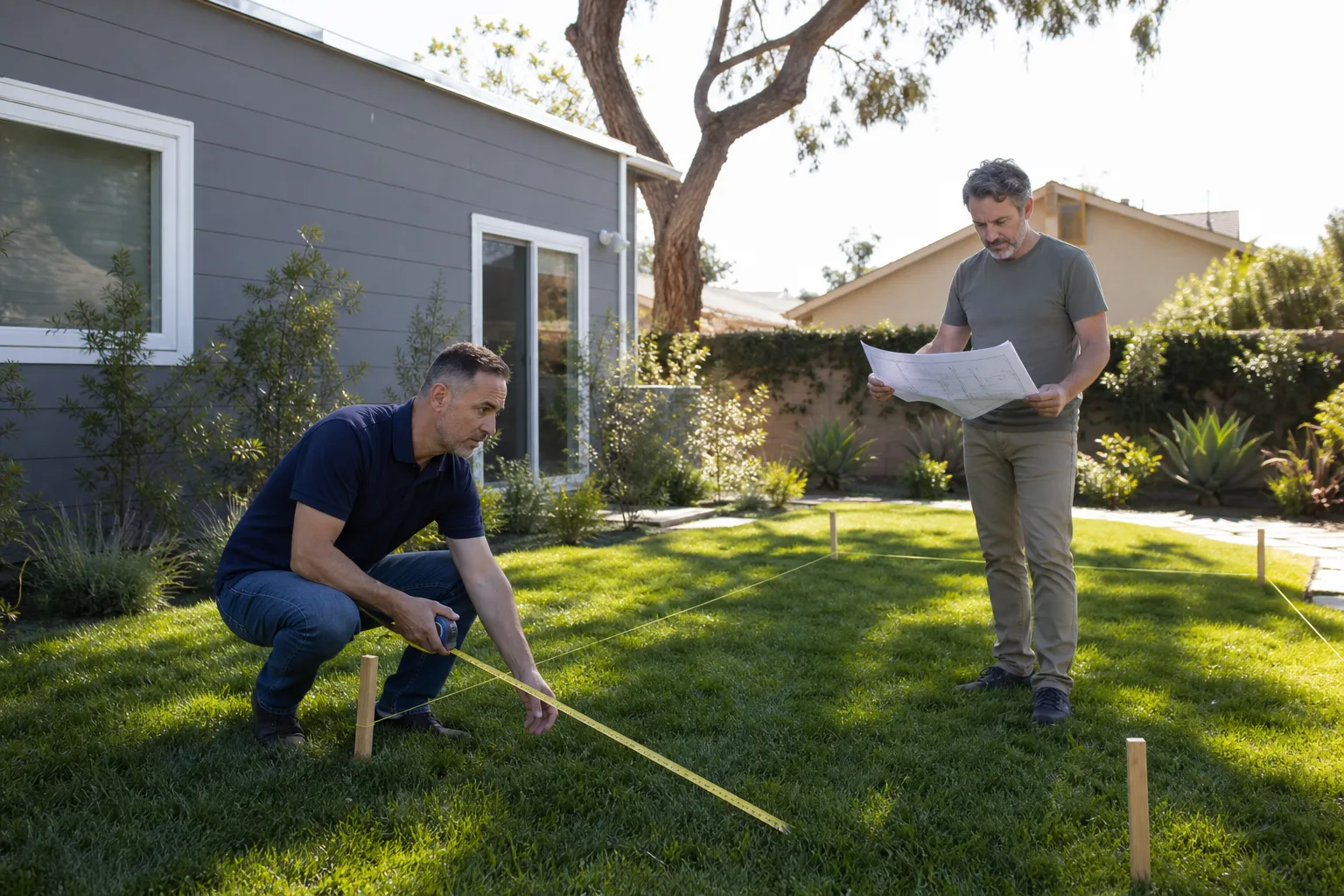
- Geotech and survey (weeks 1-3). You can’t file for a permit without a soil report and, for most projects, a property survey. These happen in parallel with design work.
- Design and structural engineering (weeks 2-8). Whether you’re working from a prefab plan or custom drawings, a Texas-licensed engineer must stamp the structural package before submission.
- Permit submission and review (weeks 8-14). City staff reviews for zoning compliance, setback adherence, drainage impact, and structural sufficiency. Expect at least one round of comments.
- Permit issuance and pre-construction (weeks 14-18). This is when SAWS and CPS Energy fees are paid, tree protection measures are confirmed, and your contractor schedules the first inspection.
- Construction (weeks 18-42 for stick-built; weeks 18-34 for prefab). Foundation, shell, mechanicals, finishes, and final inspection. Prefab compresses the middle phase because the module arrives largely complete.
- Final inspections and certificate of occupancy (weeks 40-46). The city’s final inspection includes plumbing, electrical, mechanical, and life safety. Once you have the green tag, the unit is rentable.
This is a realistic sequence, not a best-case brochure. Delays happen, especially during San Antonio’s summer months when concrete pours require early-morning scheduling, and during the holiday permit backlog from November through January. A contractor who gives you a written schedule with milestone dates rather than a verbal “it’ll be done sometime this year” is a contractor worth considering.
Common Mistakes to Avoid
- Basing your budget on the national per-square-foot average. San Antonio’s clay soil engineering requirements, SAWS fees, and CPS Energy connection costs aren’t reflected in national calculators. You’ll be undercapitalized from day one.
- Buying the prefab module before pricing site work. The factory price is not the total cost. Crane access, utility trenching, and an engineered foundation can add 40 to 60 percent to the module price on a tight San Antonio lot.
- Skipping the geotech report to save $1,200. The city won’t issue a permit without it, and trying to build on expansive clay without proper engineering is how you get cracks in your brand-new ADU two summers later.
- Underestimating the panel upgrade. Older homes in established San Antonio neighborhoods like Alta Vista and Tobin Hill frequently have 100-amp service that can’t support an ADU. The $1,800 to $4,500 upgrade is mandatory, not optional.
- Choosing a contractor based on the lowest bid without written line items. A low number with vague scope is how change orders happen. A written price with line items is the only way to know what you’re actually comparing.
- Ignoring drainage. San Antonio gets intense rain events. An ADU built without a drainage plan can channel water toward your main home’s foundation, and fixing drainage after construction costs far more than planning for it upfront.
- Not checking the homestead exemption impact. Adding an ADU can affect your property tax picture. Talk to the Bexar Appraisal District or your tax advisor before you build, not after the value hits your next statement.
When to Call a Professional
ADU construction is not a DIY project, and in San Antonio it’s not even a handyman project. You need a licensed general contractor, a Texas structural engineer, and usually a separate foundation specialist because of the soil conditions. If you’re considering an ADU and any of these apply, it’s time to bring in someone who does this every day: your existing electrical panel is 100 amps or less, your lot has visible drainage patterns or sits on a slope, you have a heritage tree within 20 feet of the planned build site, or you’ve gotten wildly different bids and can’t tell what’s included. Benson ADU San Antonio offers free estimates throughout San Antonio, with a written price before any work starts. Call (430) 258-2928 and Troy or a member of the team will walk you through what’s realistic for your specific lot.
Frequently Asked Questions
A permitted, finished ADU in San Antonio costs $210 to $320 per square foot for stick-built and $230 to $290 per square foot for prefab once site work and utility connections are included, translating to roughly $92,000 to $256,000 depending on size and finish level. These figures include Bexar County-specific costs like geotech reports, SAWS fees, and CPS Energy meter installation that national averages omit. Call (430) 258-2928 for an exact quote based on your lot, and our estimates are always free and written. For more guides & resources on San Antonio ADU construction, explore our blog.
A stick-built studio ADU on a simple rectangular footprint with mid-grade finishes is usually the lowest-cost permitted option in San Antonio, starting around $92,000 all-in for a 400 sq ft unit. A garage conversion can sometimes come in lower if the existing slab and structure are in good shape, since you save on foundation and shell costs, though electrical and plumbing upgrades can erode that advantage. Prefab units appear cheaper at the factory price but typically land slightly above stick-built once San Antonio delivery and site work are tallied.
San Antonio permits ADUs on most residentially zoned lots, but setback requirements, lot coverage maximums, and tree protection rules all vary by specific zoning district and even by neighborhood, so a parcel that works in one area may not work in another. The city’s Development Services Department offers a pre-development meeting that’s worth scheduling before you spend money on design. A licensed room addition contractor in San Antonio can also check your zoning and flag constraints during an estimate visit.
A typical stick-built ADU in San Antonio takes 9 to 11 months from first survey to final inspection, while a prefab unit from Abodu or Cover can shorten that to 7 to 9 months because the factory build happens in parallel with site work and permitting. The timeline assumes a straightforward lot without major drainage issues, tree conflicts, or utility capacity problems, and San Antonio’s holiday-season permit backlog from November through January can add several weeks to the review phase if you file during that window.
Yes, San Antonio permits ADUs to be used as long-term rental housing, and the city has taken a supportive stance toward ADUs as part of its housing affordability strategy, though short-term rentals under 30 days face separate registration requirements and have been a subject of ongoing city council debate. Long-term rentals in an ADU are broadly allowed, and units near UTSA, the Medical Center, and downtown consistently see strong tenant demand. Rental income from a San Antonio ADU typically covers the financing cost of the unit within the first 18 to 30 months depending on your neighborhood and finish level.
It shouldn’t, if your contractor writes a line-item price before work begins and your project doesn’t uncover unforeseen conditions like underground obstructions, unmarked utility lines, or soil conditions different from what the geotech report indicated. The standard San Antonio practice of verbal estimates with vague allowances is how change orders happen, which is why a written price with defined scope is the single most important thing to demand before signing. Our team at Benson ADU San Antonio provides a written price before any work starts and our 365-Day Done Right Promise means if it’s not right within a full year, we make it right.
The Bottom Line
An ADU in San Antonio is a major investment with real payback potential, but the only way to evaluate it intelligently is with local numbers, not national blog math. Expect $210 to $320 per square foot for a finished, permitted unit in 2026, with the bottom of that range reserved for straightforward stick-built studios on clean lots. Build in the San Antonio adders from day one: geotech, SAWS, CPS Energy, foundation engineering, tree protection. Compare prefab and stick-built honestly, finance deliberately, and spend your upgrade dollars on separation and convenience rather than aesthetics. If you want a written price for your specific property, our team builds room additions the same way: transparent, written, and guaranteed. Call (430) 258-2928 for a free estimate.
Written by Troy Eastman, Owner at Benson ADU San Antonio, serving San Antonio since 2006.